The unit does not match the interface
Convert a supplied value to a date, then check the unit specified by your API contract.
UnixTime · Frontend & Fullstack
Seconds from the API, milliseconds in the frontend and a local date on screen: check the individual value with UnixTime before digging into your display code.
Inspect JavaScript timestamps on Mac: convert milliseconds and nanoseconds without rounding input values.
Sound familiar?
Convert a supplied value to a date, then check the unit specified by your API contract.
Compare UTC and local representations of the same instant in the format list.
Generate a specific time and use it in your test data.
Your next time value
Copy the individual numeric timestamp received by your frontend.
Click the UnixTime menu bar icon or press ⌘⌃U (Command + Control + U). With ISO 8601 UTC selected, you get an unambiguous comparison value.
Compare the result with your UI, checking the expected unit and time zone separately.
The example uses UTC. Your output follows your selected default formats. Direct insertion via a shortcut requires macOS Accessibility permission.
Formats and keyboard shortcuts explained →
Precision for log analysis & forensics
Convert Unix timestamps with nanosecond precision. UnixTime preserves fractional seconds from numeric input timestamps. No floating-point rounding. No zeros recreated from whole seconds.
17908128001234567892026-10-01 00:00:00.123456789 UTCExample: Unix nanoseconds, a custom date format and the UTC time zone. Source accuracy still matters; conversion does not invent extra measurement precision.
| Pattern | Display precision | Example |
|---|---|---|
SSS | Milliseconds (3 digits) | .123 |
SSSSSS | Microseconds (6 digits) | .123456 |
SSSSSSSSS | Nanoseconds (9 digits) | .123456789 |
Use, for example yyyy-MM-dd HH:mm:ss.SSSSSSSSS. Nine digits display the full nanosecond fraction. Three or six display only the leading digits, without rounding up. A pattern without S does not display fractional seconds.
Keyboard shortcuts on your Mac
Copy your time value and click the menu bar icon — or press ⌘⌃U. Reassign any of the four shortcuts to suit your workflow.
⌘ = Command · ⌃ = Control · ⌥ = Option. Inserting, replacing and appending text require macOS Accessibility permission and an editable text field. Clipboard conversion does not require that permission.
Keyboard shortcuts explained →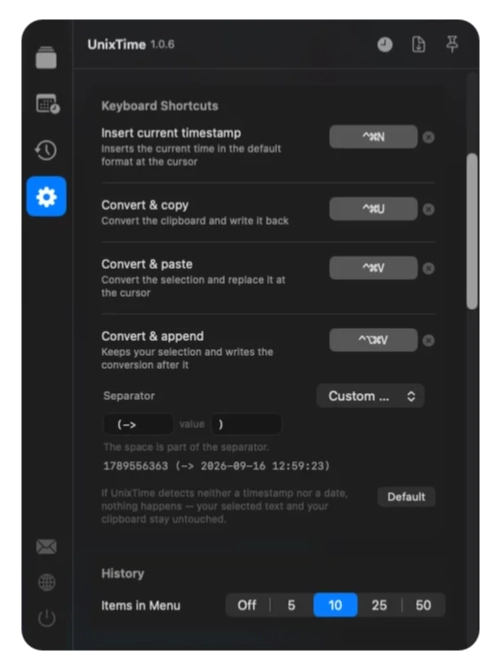
Before you start
No. It gives you a date representation of a time value. Investigating your code remains up to you.
The menu bar icon and ⌘⌃U also work while you are in API clients, editors and tickets. Your preferred output formats stay close at hand.
Use a custom date format: SSS for milliseconds (3 digits), SSSSSS for microseconds (6 digits), or SSSSSSSSS for nanoseconds (9 digits). Choose nine digits to display all available nanoseconds. Shorter patterns show only the leading digits, without rounding up.
UnixTime must be running on your Mac. All shortcuts can be reassigned. Replacing, inserting and appending text require macOS Accessibility permission and an editable destination. Converting the clipboard with the menu bar icon or ⌘⌃U does not require that permission. ⌘ means Command, ⌃ means Control and ⌥ means Option (Alt).
Yes. Conversion, the date generator and history run locally. They need neither an account nor an internet connection. UnixTime is a one-time purchase without a subscription; see the Mac App Store for the current price.
For your next timestamp
Install UnixTime, choose your default formats and try the workflow with your own time value.
